|
Surfers
Paradise
News
Gold
Coast Meter Maid photography and news media coverage
- Media Man Int and Media Man Australia online coverage
Bikini,
swimsuit, lifestyle bloggers and influences gone wild
online; Instagram, Instamodels, Facebook fashionistas
Profiles
Gold
Coast Australia
World
Directory
Hard
Rock Cafe, Surfers Paradise
Gene
Simmons visits Hard Rock Cafe, Surfers Paradise, Australia


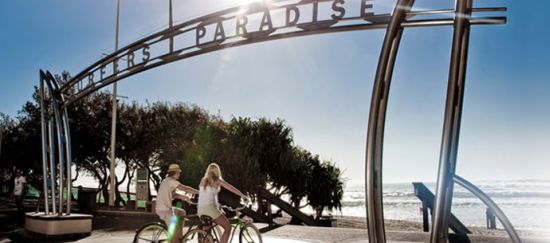
Surfers
Paradise, Gold Coast, Australia
Surfers
Paradise (28°00'S 153°25'E) is a suburb on
Australia's Gold Coast in Queensland. Colloquially
known as 'Surfers', the suburb is famous for its many
high-rise apartment buildings and wide surf beach.
The central feature of the Surfers Paradise CBD is
Cavill Mall, which runs through the centre of the
main shopping precinct.
History
James Beattie, a farmer (and no relation to current
Queensland Premier Peter Beattie) became the first
European to settle in the Surfers Paradise area when
he staked out an 80 acre farm on the northern bank
of the Nerang River, close to the location of present-day
Cavill Avenue. The farm proved unsuccessful and was
sold in 1877 to German immigrant Johann Meyer, who
turned the land into a sugar farm and mill. Meyer
also had little luck growing in the sandy soil and
within a decade had auctioned off the farm and started
a private ferry service and built the Main Beach hotel
as tourist attractions. By 1889 Meyer's hotel had
become an official postal receiving office and the
subdivisions surrounding it were given the name Elston,
named by the Southport Postmaster Mr Palmer after
his wife's home village in Nottingham, England. The
Main Beach Hotel licence lapsed after Meyer's death
in 1901 and for the next 16 years Elston was a tourist
town without a hotel or post office.
In
1917 a land auction was held by Brisbane real estate
company Arthur Blackwood Ltd, who were trying to sell
subdivided blocks in Elston as the 'Surfers' Paradise
Estate', but the auction failed because access to
the area was still too difficult. This was the first
recorded reference to the Surfers Paradise name, but
like the Gold Coast, the title may well have been
part of local vernacular prior to the land auction.
Elston
began to get considerably more visitors after the
opening of the Jubilee Bridge in 1925 and the extension
of the South Coast Road; the area was serviced until
that time only by Meyer's Ferry at the Nerang River.
Suddenly, Elston was no longer cut off by the river
and speculators began buying up land around the villages
of Elston, and Burleigh Heads. Estates down the coast
were heavily promoted and hotels began opening to
accommodate both tourists and investors.
Brisbane
hotelier Jim Cavill opened the Surfers Paradise Hotel
that same year, and suddenly the town had its first
real landmark. Located between the ferry jetty and
the white surf beach just off the South Coast Road,
it became a popular spot and various shops and services
sprang up around it. In the following years Cavill
led a push to have the name Elston changed to the
more marketable Surfers' Paradise and in 1933 his
lobbying paid off and the town officially acquired
its present name.
The
boom of the 1950s and 1960s was largely centred on
this area and the first of the tall apartment buildings
that now characterise the skyline were constructed
in the decades that followed. Little remains of the
early vegetation or natural features of the area and
even the historical association of the beachfront
development with the river is tenuous. The early subdivision
pattern remains, although later reclamation of the
islands in the Nerang River as housing estates, and
the bridges to those islands, has created a contrast
reflected in subdivision and building form. Some early
remnants survived such as Budd's Beach — a low-scale
open area on the river which even in the early history
of the area was a centre for boating, fishing and
swimming.
Some
minor changes have occurred in extending the road
along the beachfront since the early subdivision and
The Esplanade road is now very much a focus of activity
in this part of the Gold Coast. Promenading and people-watching
takes place in this area where land use encourages
not only residential activity but tourism with supporting
shops and restaurants. The intensity of activity,
centred on Cavill, Orchid and Elkhorn Avenues, is
reflected in the density of building development.
Of all places on the Gold Coast the buildings in this
area constitute a dominant and enduring image visible
from many vantage points in the city from as far south
as Coolangatta as well as from the mountain resorts
of the hinterland and beyond.
Foreshoreways
The Gold Coast Oceanway travels along a beachfront
alignment between Narrowneck and Surfers Central but
then diverts inland to travel along a narrow corridor
along Garfield and Northcliffe Terraces behind the
beachfront highrises. Gold Coast City Council proposed
to create a new Oceanway pavement along the public
road reserve between the highrise buildings and the
dunes but there was considerable opposition from local
residents.
The
Surfers Riverwalk travels along the Nerang River foreshores
through Surfers Paradise.
Events
Since
1991 the Champ Car World Series has run an annual
race on the streets of Surfers Paradise, an event
currently known as the Lexmark Indy 300.
Each
Wednesday there is a night market held along the beachside
boardwalk at the top of Cavill St., and on Friday
nights as well in the summer.
Schoolies
week is celebrated by around 50,000 high school graduates
each November.
Trivia
In the post-apocalyptic world of Mad Max 2: The Road
Warrior, the "paradise" that the refugees
hoped to reach is none other than Surfers Paradise.
Surfers Paradise beach was voted as one of the best
beaches in the world by the American Travel Channel.
Surfers Paradise beach was judged Queensland's Cleanest
Beach in 2006 by the Keep Australia Beautiful Council
(Credit:
Wikipedia)
|