|
New
York



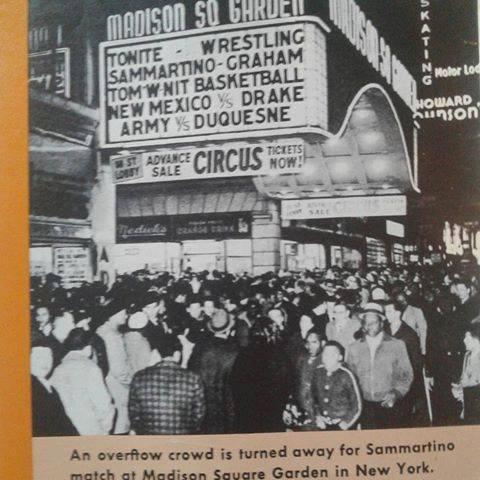
Profiles Madison
Square Garden WWE
Gizzi's Cafe
United States 
Website Madison
Square Garden 
Promotions Sammartino:
The Legend Lives Collection intro (WWE Network Exclusive) 
News Donald
Trump announced for WWE Hall of Fame 2013: Celebrity wing Wrestling
News Media: WWE, Hall of Fame 2013: Bruno Sammartino, Donald Trump for celebrity
wing...Feb 2013 Profiles Madison
Square Garden New
York Stock Exchange United
States America
Donald Trump Don
King Travel
and Tourism World
Directory 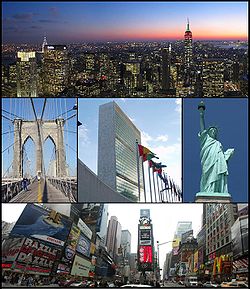
Profile New
York is the third most populous state of the United
States of America. Located
in the Mid-Atlantic region, New York is bordered by Vermont, Massachusetts, Connecticut,
New Jersey, and Pennsylvania. It also shares an international border with Canada.
The state's five largest cities are New York City, Buffalo, Rochester, Yonkers,
and Syracuse. The state has 62 counties. New
York is known for its history as a gateway for immigration to the United States
and its status as a transportation and manufacturing center. New
York was inhabited by Algonquian and Iroquois Native Americans at the time Dutch
and French settlers arrived in the 16th century. New York was forted by the Dutch
at Albany in 1614 and colonized in 1624, at both Albany and Manhattan, before
falling under English rule in 1664. About one third of all the military engagements
of the American Revolution took place in New York, after which it became the 11th
state to ratify the United States Constitution in 1788. Geography
Geography of New York
New York covers 54,475 sq miles (141,089 sq kilometers).
In size, New York ranks 27th compared with the other 50 states. The Great Appalachian
Valley dominates eastern New York, while Lake Champlain is the chief northern
feature of the valley, which also includes the Hudson River flowing southward
to the Atlantic Ocean. The rugged Adirondack Mountains, with vast tracts of wilderness,
lie west of the valley. Most of the southern part of the state is on the Allegheny
plateau, which rises from the southeast to the Catskill Mountains. The western
section of the state is drained by the Allegheny River and rivers of the Susquehanna
and Delaware systems. The Delaware River Basin Compact, signed in 1961 by New
York, New Jersey, Pennsylvania, Delaware, and the federal government, regulates
the utilization of water of the Delaware system. New
York's borders touch (clockwise from the north) two Great Lakes (Erie and Ontario,
which are connected by the Niagara River); one former Great Lake (Lake Champlain);
the provinces of Ontario and Quebec in Canada; three New England states (Vermont,
Massachusetts, and Connecticut); the Atlantic Ocean, and two Mid-Atlantic states
(New Jersey and Pennsylvania). In addition, Rhode Island shares a water border
with New York. While
the state is best known for New York City's urban atmosphere, especially Manhattan's
skyscrapers, most of the state is dominated by farms, forests, rivers, mountains,
and lakes. New York's Adirondack State Park is larger than any U.S. National Park
outside of Alaska. Niagara Falls, on the Niagara River as it flows from Lake Erie
to Lake Ontario, is a popular attraction. The Hudson River begins with Lake Tear
of the Clouds and flows south through the eastern part of the state without draining
Lakes George or Champlain. Lake George empties at its north end into Lake Champlain,
whose northern end extends into Canada, where it drains into the Richelieu and
then the St Lawrence Rivers. Four of New York City's five boroughs are on the
three islands at the mouth of the Hudson River: Manhattan Island, Staten Island,
and Brooklyn and Queens on Long Island. "Upstate"
is a common term for New York State counties north of suburban Westchester, Rockland
and Dutchess counties. Upstate New York typically includes the Catskill and Adirondack
Mountains, the Shawangunk Ridge, the Finger Lakes and the Great Lakes in the west;
and Lake Champlain, Lake George, and Oneida Lake in the northeast; and rivers
such as the Delaware, Genesee, Mohawk, and Susquehanna. The highest elevation
in New York is Mount Marcy in the Adirondacks. Climate
The climate of New York State is broadly representative of the humid continental
type, which prevails in the northeastern United States, but its diversity is not
usually encountered within an area of comparable size. Masses of cold, dry air
frequently arrive from the northern interior of the continent. Prevailing winds
from the south and southwest transport warm, humid air, which has been conditioned
by the Gulf of Mexico and adjacent subtropical waters. These two air masses provide
the dominant continental characteristics of the climate. A third great air mass
flows inland from the North Atlantic Ocean and produces cool, cloudy, and damp
weather conditions. Nearly
all storm and frontal systems moving eastward across the continent pass through
or in close proximity to New York State. Storm systems often move northward along
the Atlantic coast and have an important influence on the weather and climate
of Long Island and the lower Hudson Valley. Frequently, areas deep in the interior
of the state feel the effects of such coastal storms. The
winters are long and cold in the Plateau Divisions of the state. In the majority
of winter seasons, a temperature of -25° or lower can be expected in the northern
highlands (Northern Plateau) and -15° or colder in the southwestern and east-central
highlands (Southern Plateau). The Adirondack region records from 35 to 45 days
with below zero temperatures in normal to severe winters. The
summer climate is cool in the Adirondacks, Catskills, and higher elevations of
the Southern Plateau. The New York City area and lower portions of the Hudson
Valley have rather warm summers by comparison, with some periods of high, uncomfortable
humidity. The remainder of New York State enjoys pleasantly warm summers, marred
by only occasional, brief intervals of sultry conditions. Summer daytime temperatures
usually range from the upper 70s to mid 80s over much of the State, producing
an atmospheric environment favorable to many athletic, recreational, and other
outdoor activities.
State parks
Long Pond in the Saint Regis Canoe Area of the Adirondack
State Park.See also: List of New York state parks
New York has many state
parks and two major forest preserves. Adirondack State Park, roughly the size
of the state of Vermont and the largest state park in the United States, was established
in 1892 and given state constitutional protection in 1894. The thinking that lead
to the creation of the Park first appeared in George Perkins Marsh's Man and Nature,
published in 1864. Marsh argued that deforestation could lead to desertification;
referring to the clearing of once-lush lands surrounding the Mediterranean, he
asserted "the operation of causes set in action by man has brought the face
of the earth to a desolation almost as complete as that of the moon."
The
Catskill State Park was protected in legislation passed in 1885, which declared
that its land was to be conserved and never put up for sale or lease. Consisting
of 700,000 acres (2,800 km²) of land, the park is a habitat for bobcats,
minks and fishers. There are some 400 black bears living in the region. The state
operates numerous campgrounds and there are over 300 miles (480 km) of multi-use
trails in the Park.
History
History of New York
An early Dutch map of the Hudson river
valley c. 1635 (North is to the right)The area was long inhabited by the Lenape;
Lenape in canoes met Giovanni da Verrazzano, the first European explorer to enter
New York Harbor, in 1524. Giovanni da Verrazzano named this place Nouvelle Angoulême
(New Angouleme) in honor of the French king François I. A French explorer
and mapper, Samuel de Champlain, described his explorations through New York in
1608. A year later Henry Hudson, an Englishman working for the Dutch, claimed
the area in the name of the Netherlands. It was to be called New Amsterdam.
The
Dutch, who began to establish trading posts on the Hudson River in 1613, claimed
jurisdiction over the territory between the Connecticut and the Delaware Rivers,
which they called New Netherlands. The government was vested in "The United
New Netherland Company," chartered in 1614, and then in "The Dutch West
India Company," chartered in 1622. In
1649, a convention of the settlers petitioned the "Lords States-General of
the United Netherlands" to grant them "suitable burgher government,
such as their High Mightinesses shall consider adapted to this province, and resembling
somewhat the government of our Fatherland," with certain permanent privileges
and exemptions, that they might pursue "the trade of our country, as well
along the coast from Terra Nova to Cape Florida as to the West Indies and Europe,
whenever our Lord God shall be pleased to permit." The
Hudson River has long been an essential transportation corridor for the state.The
directors of the West India Company resented this attempt to shake their rule
and wrote their director and council at New Amsterdam: "We have already connived
as much as possible at the many impertinences of some restless spirits, in the
hope that they might be shamed by our discreetness and benevolence, but, perceiving
that all kindnesses do not avail, we must, therefore, have recourse to God to
Nature and the Law. We accordingly hereby charge and command your Honors whenever
you shall certainly discover any Clandestine Meetings, Conventicles or machinations
against our States government or that of our country that you proceed against
such malignants in proportion to their crimes." These
grants embraced all the lands between the west bank of the Connecticut River and
the east bank of the Delaware River. In
1663 the Duke of York purchased the grant of Long Island and other islands on
the New England coast made in 1635 to the Earl of Stirling, and, in 1664, the
Duke equipped an armed expedition, which took possession of New Amsterdam, which
was thenceforth called New York, after the Duke. This conquest was confirmed by
the treaty of Breda, in July 1667. In July 1673, a Dutch fleet recaptured New
York and held it until it was restored to the English by the treaty of Westminster
in February, 1674. New
York was established by its colonial charter. This constitution was framed by
a convention which assembled at White Plains, New York on July 10, 1776, and after
repeated adjournments and changes of location, terminated its labors at Kingston,
New York on Sunday evening, April 20, 1777, when the constitution was adopted
with but one dissenting vote. It was not submitted to the people for ratification.
It was drafted by John Jay. The
western part of New York had been settled by the six nations of the Iroquois Confederacy
for at least 500 years before Europeans came. The Iroquois had maintained the
area between Seneca and Cayuga Lakes as a grassland prairie, which abounded in
wild game including grazing American Bison herds. In colonial times, the Iroquois
were prosperously growing corn, vegetables and orchards, and keeping cows and
hogs; fish were also abundant. The
colonial charter of New York granted unlimited westward expansion, despite Native
American presence in the Area. Massachusetts' charter had the same provision,
causing territorial disputes between the colonies and with the Iroquois. During
the revolution, four of the Iroquois nations fought on the side of the British,
with one exception the Oneidas. In 1779, Major General John Sullivan was sent
to defeat the Iroquois. The Sullivan Expedition moved northward through the Finger
Lakes and Genesee Country, burning all the Iroquois communities and destroying
their crops and orchards. Refugees fled to Fort Niagara where they spent the following
winter in hunger and misery. Hundreds died of exposure, hunger and disease. After
the war, many moved to Canada. For
the Oneida nation's assistance in defeating the British, primarily assisting General
Washington's army at Valley Forge, then President Washington while on tour of
the Mohawk Valley signed the Treaty of Canandaigua. This Treaty promised the Oneidas
among other things a large swath of land from Pennsylvania to Canada, forever.
The Treaty was violated in the mid-1800s by New York State. This became the basis
for the present land claim dispute. New
York was one of the original thirteen colonies that became the United States.
It was the 11th state to ratify the United States Constitution, on July 26, 1788. The
creation of the Erie Canal lead to rapid industrialization in New York.Transportation
in western New York was difficult before canals were built in the early part of
the nineteenth century. The Hudson and Mohawk Rivers could be navigated only as
far as Central New York. While the St. Lawrence River could be navigated to Lake
Ontario, the way westward to the other Great Lakes was blocked by Niagara Falls,
and so the only route to western New York was over land. Governor DeWitt Clinton
strongly advocated building a canal to connect the Hudson River with Lake Erie,
and thus all the Great Lakes. Work commenced in 1817, and the Erie Canal was finished
in 1825. The canal opened up vast areas of New York to commerce and settlement,
and enabled port cities such as Buffalo to grow and prosper. The Welland Canal
was completed in 1972. Sullivan's
men returned from the campaign to Pennsylvania and New England to tell of the
enormous wealth of this new territory. Many of them were given land grants in
gratitude for their service in the Revolution. From 1786 through 1797 several
groups of wealthy land speculators entered into agreements with one another, with
neighboring states, and with the Indians to obtain title to vast tracts of land
in western New York. Some purchases of Iroquois lands are the subject of numerous
modern-day land claims by the individual nations of the six nations. Demographics As
of 2006, New York was the third largest state in population after California and
Texas, with an estimated population of 19,306,183.[2] This represents an increase
of 329,362, or 1.7%, since the year 2000; it includes a natural increase since
the last census of 601,779 people (1,576,125 births minus 974,346 deaths) and
a decrease due to net migration of 422,481 people out of the state. Immigration
from outside the United States resulted in a net increase of 820,388 people, and
migration within the country produced a net loss of about 800,213 New
York is a slow growing state with a large rate of emigration to other states,
especially Florida and Arizona. New York state is a leading destination for international
immigration, however. The center of population of New York is located in Orange
County, in the town of Deerpark.[3] New York City and its six suburban counties
have a combined population of 12,626,200 people, or 65.67% of the state's population. Racial
and ancestral makeup
The major ancestry groups in New York state are African
American (15.8%), Italian (14.4%), Hispanic (14.2%), Irish (12.9%), and German
(11.1%). According to a 2004 estimate, 20.4% of the population is foreign-born. New
York is home to the largest Puerto Rican and Dominican population in the United
States. The New York City neighborhood of Harlem has historically been a major
cultural capital for African-Americans. Queens, also in New York City, is home
to the state's largest Asian-American population. New
York ethnic distributionIn the 2000 Census, Italian-Americans make up the largest
ancestral group in Staten Island and Long Island, followed by Irish-Americans.
Albany and southeast-central New York are heavily Irish-American and Italian-American.
In Buffalo and western New York, German-Americans are the largest group; in the
northern tip of the state, French-Canadians. 6.5%
of New York's population were under 5 years of age, 24.7% under 18, and 12.9%
were 65 or older. Females made up 51.8% of the population. New
York State has a higher number of Italian-Americans than any other U.S. state. According
to the 2000 U.S. Census, 13.61% of the population aged 5 and over speak Spanish
at home, while 2.04% speak Chinese (including Cantonese and Mandarin), 1.65% Italian,
and 1.23% Russian.
Religion
Catholics comprise more than 40% of the population in New York.[5]
Protestants are 30% of the population, Jews 5%, Muslims 3.5%, Buddhists 1%, and
13% claim no religious affiliation.
Economy
Midtown Manhattan in New York City is home to the greatest concentration
of Fortune 500 companies in the world.
A
dairy farm near Oxford, New York.New York's gross state product in 2005 was $963.5
billion, ranking third in size behind the larger states of California and Texas.[6]
If New York were an independent nation, it would rank as the 16th largest economy
in the world behind South Korea. Its 2005 per capita personal income was $50,038,
an increase of 5.9% from 2004, placing it fifth in the nation behind Massachusetts,
and eighth in the world behind Ireland. New York's agricultural outputs are dairy
products, cattle and other livestock, vegetables, nursery stock, and apples. Its
industrial outputs are printing and publishing, scientific instruments, electric
equipment, machinery, chemical products, and tourism. New
York exports a wide variety of goods such as foodstuffs, commodities, minerals,
manufactured goods, cut diamonds, and automobile parts. New York's five largest
export markets in 2004 were Canada ($30.2 billion), United Kingdom ($3.3 billion),
Japan ($2.6 billion), Israel ($2.4 billion), and Switzerland ($1.8 billion). New
York's largest imports are oil, gold, aluminum, natural gas, electricity, rough
diamonds, and lumber. Canada
is a very important economic partner for the state. 23% of the state's total worldwide
exports went to Canada in 2004. Tourism from the north is also a large part of
the economy. Canadians spent US$487 million in 2004 while visiting the state. New
York City is the leading center of banking, finance and communication in the United
States and is the location of the New York Stock Exchange, the largest stock exchange
in the world by dollar volume. Many of the world's largest corporations are based
in the city. The
state also has a large manufacturing sector that includes printing and the production
of garments, furs, railroad equipment and bus line vehicles. Many of these industries
are concentrated in upstate regions. Albany and the Hudson Valley are major centers
of nanotechnology and microchip manufacturing, while the Rochester area is important
in photographic equipment and imaging. New
York is a major agricultural producer, ranking among the top five states for agricultural
products including dairy, apples, cherries, cabbage, potatoes, onions, maple syrup
and many others. The state is the largest producer of cabbage in the U.S. The
state has about a quarter of its land in farms and produced US$3.4 billion in
agricultural products in 2001. The south shore of Lake Ontario provides the right
mix of soils and microclimate for many apple, cherry, plum, pear and peach orchards.
Apples are also grown in the Hudson Valley and near Lake Champlain. The south
shore of Lake Erie and the southern Finger Lakes hillsides have many vineyards.
New York is the nation's third-largest grape-producing state, behind California,
and second largest wine producer by volume. In 2004, New York's wine and grape
industry brought US$6 billion into the state economy. The state has 30,000 acres
(120 km²) of vineyards, 212 wineries, and produced 200 million bottles of
wine in 2004. A moderately sized saltwater commercial fishery is located along
the Atlantic side of Long Island. The principal catches by value are clams, lobsters,
squid, and flounder. Transportation
Transportation in New York
The New York City subway is the largest mass
transit system in the world by number of stations.New York boasts the most extensive
and one of the oldest transportation infrastructures in the country. Engineering
difficulties because of the terrain of the state and the unique issues of the
city brought on by urban crowding have had to be overcome since the state was
young. Population expansion of the state generally followed the path of the early
waterways, first the Hudson River and then the Erie Canal. Today, railroad lines
and the New York State Thruway follow the same general route. The New York State
Department of Transportation is often criticized for how they maintain the roads
of the state in certain areas for the fact that the tolls collected along the
roadway have long passed their original purpose. Until 2006, tolls were collected
on the Thruway within The City of Buffalo. They were dropped late in 2006 during
the campaign for Governor (both candidates called for their removal).
The Bear Mountain Bridge crossing the Hudson River.New York City is home to the
most complex and extensive transportation network in the United States, with more
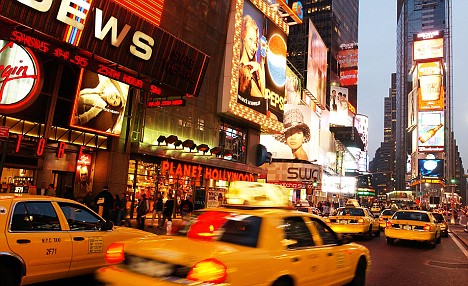
than 12,000 iconic yellow cabs, 120,000 daily bicyclists,[8] a massive subway
system, bus and railroad systems, immense airports, landmark bridges and tunnels,
ferry service and even an aerial commuter tramway. About one in every three users
of mass transit in the United States and two-thirds of the nation's rail riders
live in New York and its suburbs.
Three
suburban commuter railroad systems enter and leave New York City, including the
Long Island Rail Road, MTA Metro-North, the PATH system and five of NJTransit's
rail services. Besides
New York City, many of the other cities have urban and regional public transportation.
Syracuse is the smallest city in the U.S. to have a commuter rail line, known
as OnTrack. Buffalo also has a Subway line, sometimes called a Lightrail System
run by the NFTA, and Rochester had a subway system, although it is mostly destroyed.
Only a small part exists under the old Erie Canal Aquaduct. Portions
of the transportation system are intermodal, allowing travelers to easily switch
from one mode of transportation to another. One of the most notable examples is
AirTrain JFK which allows rail passengers to travel directly to terminals at Kennedy
Airport. Politics
and government
Government of New York
New York State Capitol Building.Under
its present constitution (adopted in 1894), New York is governed by three branches
of government: the executive branch, consisting of the Governor of New York and
the other independently elected constitutional officers; the legislative branch,
consisting of the the bicameral New York State Legislature; and the judicial branch,
consisting of the state's highest court, the New York Court of Appeals, and lower
courts. The state has two U.S. senators, 31 members in the United States House
of Representatives, and 33 electoral votes in national presidential elections
(a drop from its 41 votes in 1970). New
York's capital is Albany. The state's subordinate political units are its 62 counties.
Other officially incorporated governmental units are towns, cities, and villages.
New York has more than 4,200 local governments that take one of these forms. About
52% of all revenue raised by local governments in the state is raised solely by
the government of New York City, which is the largest municipal government in
the United States. The
state has a strong imbalance of payments with the federal government. New York
state receives 82 cents in services for every $1 it sends in taxes to the federal
government in Washington. The state ranks near the bottom, in 42nd place, in federal
spending per tax dollar. Many
of New York's public services are carried out by public benefit corporations,
frequently called authorities or development corporations. Well known public benefit
corporations in New York include the Metropolitan Transportation Authority, which
oversees New York City's public transportation system, and the Port Authority
of New York and New Jersey, a bi-state transportation infrastructure agency. New
York's legal system is explicitly based on English common Law. Capital punishment
was declared unconstitutional in 2004.
Politics
Politics of New York
New York State consistently supports candidates belonging
to the Democratic Party in national elections. Democratic presidential candidate
John Kerry won New York State by 18 percentage points in 2004, while Democrat
Al Gore won the state by an even larger margin in 2000. New York City is a major
Democratic stronghold with liberal politics. Many of the state's other urban areas,
including Albany, Ithaca, Buffalo, Rochester, and Syracuse are also Democratic.
Rural upstate New York, however, is generally more conservative than the cities
and tends to favor Republicans. Heavily populated suburban areas such as Westchester
County and Long Island have swung between the major parties over the past 25 years
and often have tightly contested local elections. New
York City is the most important source of political fund-raising in the United
States for both major parties. Four of the top five zip codes in the nation for
political contributions are in Manhattan. The top zip code, 10021 on the Upper
East Side, generated the most money for the 2000 presidential campaigns of both
George Bush and Al Gore. Republican Presidential candidates will often skip campaigning
in the state, taking it as a loss and focusing on vital swing states.
Cities and towns
The
largest city in the state and the most populous city in the United States is New
York City, which is comprised of five counties, the Bronx, Manhattan, Queens,
Brooklyn, and Staten Island. New York City is home to more than two-fifths of
the state's population. Buffalo is the second largest city in the state. The smallest
city is Sherrill, New York, located just west of the Town of Vernon in Oneida
County. Albany is the state capital, and the Town of Hempstead is the civil township
with the largest population. The
southern tip of New York State—New York City, its suburbs including Long
Island, the southern portion of the Hudson Valley, and most of northern New Jersey—can
be considered to form the central core of a "megalopolis," a super-city
stretching from the northern suburbs of Boston to the southern suburbs of Washington
D.C. in Virginia and therefore occasionally called "BosWash". First
described by Jean Gottmann in 1961 as a new phenomenon in the history of world
urbanization, the megalopolis is characterized by a coalescence of previous already-large
cities of the Eastern Seaboard: a heavy specialization on tertiary activity related
to government, trade, law, education, finance, publishing and control of economic
activity; plus a growth pattern not so much of more population and more area as
more intensive use of already existing urbanized area and ever more sophisticated
links from one specialty to another. Several other groups of megalopolis-type
super-cities exist in the world, but that centered around New York City was the
first described and still is the best example.
Education
Education in New York
Cornell University is New York's
land-grant university.
Primary, middle-level, and secondary education
The University of the State of New York (USNY) (distinct from the State University
of New York, known as SUNY), its policy-setting Board of Regents, and its administrative
arm, the New York State Education Department, oversee all public primary, middle-level,
and secondary education in the state. The New York City Department of Education,
which manages the public school system in New York City, is largest school district
in the United States with more students than the combined population of eight
U.S. states. Over 1 million students are taught in more than 1,200 separate schools.
Public
secondary education in the state consists of high schools that teach elective
courses in trades, languages, and liberal arts with tracks for gifted, college-bound
and industrial arts students. New York is one of seven states that mandates the
teaching of Holocaust and genocide studies at some point in elementary or secondary
school curriculums.
Colleges and universities
New York's statewide public university system is
the State University of New York (SUNY). With a total enrollment of 413,000 students
and 1.1 million continuing education students spanning 64 campuses across the
state, SUNY is the largest public university system in the United States.
Butler
library at Columbia University in New York City the wealthiest university in the
state of New York.The City University of New York (CUNY) is the public university
system of New York City and is independent of the SUNY system. It is the largest
urban university in the United States, with 11 senior colleges, 6 community colleges,
a doctorate-granting graduate school, a journalism school, a law school and the
Sophie Davis School of Biomedical Education. More than 450,000 degree-credit,
adult, continuing and professional education students are enrolled at campuses
located in all five New York City boroughs. New
York is also home to such notable private universities as Columbia University,
New York University, the Rochester Institute of Technology, Union College and
Syracuse University. New York has hundreds of other private colleges and universities,
including many religious and special-purpose institutions. The state's land-grant
university is Cornell University, a private university. New
York is the nation’s largest importer of college students, according to statistics
which show that among freshmen who leave their home states to attend college,
more come to New York than any other state, including California. Sports
Main article: Sports in New York
New York hosted the 1980 Winter Olympics
at Lake Placid, the Games known for the USA-USSR hockey game dubbed the "Miracle
on Ice" in which a group of American college students and amateurs defeated
the heavily-favored Soviet national ice hockey team 4-3 and went on to win the
gold medal. Lake Placid also hosted the 1932 Winter Olympics. Along with St. Moritz,
Switzerland and Innsbruck, Austria, it is one of the three places to have twice
hosted the Winter Olympic Games. List
of Professional Sports Organizations New
York Yankees New
York Mets New
York Jets New
York Giants Buffalo
Bills Buffalo
Sabres New
York Rangers New
York Islanders New
York Knicks Navy
vessel namesakes
There have been at least five United States Navy ships named USS New York in honor
of the state. USS New York (LPD-21) was laid down on September 10 2004 and will
be the sixth Navy ship to be named for the state. (Credit:
Wikipedia). Websites City
Of New York The
New York Times New
York Post Profiles Donald
Trump Johnny
Valiant Evan
Ginzburg Howard
Stern Danny
Schechter
Don King Profiles NYC
TV Profiles WrestleMania Madison
Square Garden Dr.
Sketchy's Anti-Art United
States World
Articles The
Great Showman Dead When
You Wish Upon A Star Blogs New
York Media |