|
Mad
Max
PartyCasino.com
website PartyCasino.com
profile PartyGaming
profile

Profiles
Mel
Gibson Movies
Hollywood
Australia

TOP
GUN online slot profile
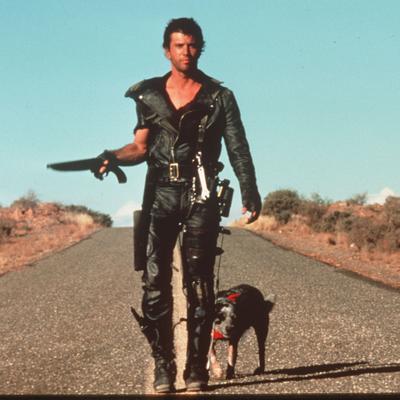
Mad
Max is an Australian apocalyptic action thriller film
from 1979 directed by George Miller and written by
Miller and Byron Kennedy. The film, starring the then
little-known Mel Gibson, was released internationally
in 1980.
This
low-budget film's story of social breakdown, murder,
and vengeance became the top-grossing Australian film,
and has been credited for opening up the global market
to Australian films. The movie was also notable for
being the first Australian film to be shot with a
widescreen anamorphic lens.
Mad
Max was followed by two sequels, Mad Max 2: The Road
Warrior and Mad Max: Beyond Thunderdome. As of April,
2008, a third sequel, Mad Max 4: Fury Road, remains
"in pre-production."
Plot
summary
The
story is set in Australia in the near future, depicting
a poorly-funded police unit called the Main Force
Patrol (MFP), which struggles to protect the Outback's
few remaining townspeople from violent motorcycle
gangs. The film depicts the future Australia as a
bleak, dystopian and impoverished society that is
facing a breakdown of civil order, the causes of which
are not detailed in this film but which Mad Max 2:
The Road Warrior explains as being caused by widespread
oil shortages and Mad Max: Beyond Thunderdome explains
resulted in a nuclear war following the shortages.
The film introduces a young MFP police officer, Max
Rockatansky (Mel Gibson), who is considered to be
the MFP's "top pursuit man".
One
of the biker gang members, nicknamed the Nightrider,
escapes from police custody by killing an officer
and stealing his vehicle. Max pursues the Nightrider
in a high-speed chase, which results in the Nightrider's
death by fiery explosion. Following the dangerous
chase, which resulted in injuries for a number of
officers, the police chief warns Max (who thinks nothing
of it at the time) that now the bandits are out for
him because of the death of the Nightrider.
The
biker gang, which is led by the Toecutter (Hugh Keays-Byrne)
plans to avenge Nightrider's death by killing MFP
officers. Toecutter's young protegé, the biker
Johnny the Boy (played by Tim Burns), sets a trap
for Max's close friend and fellow officer, Jim Goose
(played by actor Steve Bisley). When Goose's vehicle
is flipped over, the bikers burn him alive ("the
Goose is cooked") in retaliation for the Nightrider's
death. The Goose survives and Max, after seeing Goose's
charred body in the hospital's burn ward, becomes
angered and disillusioned with the police force. He
resigns from the MFP with no intentions to return.
Max takes a road trip to spend time with his wife
and infant son in the relatively peaceful coastal
area north of their region.
Meanwhile,
the gang's vicious leader, the Toecutter, is still
thirsting for revenge against Max. The two cross paths
once more when Max and his family are on vacation
in a remote beachfront area. The gang runs down Max's
wife (played by Joanne Samuel) and son, leaving their
crushed bodies in the middle of the road. Max arrives
too late to intervene. His son is pronounced dead
on the scene, while his wife suffers massive injuries.
(It is revealed in Mad Max 2: The Road Warrior that
she later died from her injuries.)
Filled
with a burning, obsessive anger, Max once again dons
his leather police outfit and straps on his sawn-off
shotgun. Driving the supercharged, black Pursuit Special,
he goes out to avenge the death of his family. He
hunts down and kills the gang members one by one,
including the Toecutter. When Max finds Johnny the
Boy, he handcuffs his ankle to a wrecked, overturned
vehicle with a ruptured gas tank. Max lights a crude
time-delay fuse and gives Johnny a hack saw, leaving
him the choice of trying to saw through the handcuffs
(10 minutes) or his ankle (five minutes). Over Johnny's
hysterics, an embittered Max drives off into the desolate
Outback as the fuse he constructed explodes behind
him, presumably killing Johnny.
Conception
George
Miller was a medical doctor in Australia, working
in a hospital emergency room, where he saw many injuries
and deaths of the types depicted in the movie. While
in residency at a Melbourne hospital, he met amateur
film maker Byron Kennedy at a summer film school in
1971. The duo produced the short film Violence in
the Cinema, Part 1, which was screened at a number
of film festivals and won several awards. Eight years
later, the duo created Mad Max, with the assistance
of first time screenwriter James McCausland (who appears
in the film as the bearded man in an apron in front
of the diner).
Miller
believed that audiences would find his violent story
to be more believable if set in a bleak, dystopic
future.
The
film was shot over a period of twelve weeks in Australia,
between December 1978 and February 1979, just outside
Melbourne. Many of the car-chase scenes for the original
Mad Max were filmed near the town of Lara, just north
of Geelong (Victoria, Australia). The movie was shot
with a widescreen anamorphic lens, the first Australian
film to use one.
Mel
Gibson, a complete unknown at this point, went to
auditions with his friend and classmate Bisley (who
would later land the part of Jim Goose). Gibson went
to auditions in poor shape, as the night before he
had gotten into a drunken brawl with three men at
a party, resulting in a swollen nose, a broken jawline,
and various other bruises. Mel showed up at the audition
the next day looking like a "black and blue pumpkin"
(his own words). Mel did not expect to get the role
and only went to accompany his friend. However, the
casting agent liked the look and told Mel to come
back in two weeks, telling him "we need freaks."
When Gibson returned, he was not recognized because
his wounds had healed almost completely; he received
the part anyway.
Due
to the film's low budget, only Mel Gibson was given
a jacket and pants made from real leather. All the
other actors playing police officers wore vinyl outfits.
The police cars were repeatedly repainted to give
the illusion that more cars were used; often they
were driven with the paint still wet. The film's post-production
was done in Kennedy's house, with Wilson and Byron
editing the film in Byron's bedroom on a home-built
editing machine that Byron's father, an engineer,
had designed for them. The duo also edited the sound
in Kennedy's house.
Success
The
film was very successful at the box office, holding
a record in Guinness Book of Records as the highest
profit-to-cost ratio of a motion picture, conceding
the record only in 2000 to The Blair Witch Project.
Mad Max was independently financed with a reported
budget of $300,000 AUD; of which $15,000 was paid
to Mel Gibson for his performance. The movie went
on to earn $100 million worldwide. The film was awarded
four Australian Film Institute Awards in 1979.
When
the film was first released in America, all the voices,
including that of Mel Gibson's character, were dubbed
by U.S. performers at the behest of the distributor,
American International Pictures, for fear that audiences
would not take warmly to actors speaking entirely
with Australian accents. Much of the Australian slang
and terminology was also replaced with American usages
(examples: "See looks!" became "Look
see!", "windscreen" became "windshield",
"very toey" became "super hot",
and "probie" became "rookie").
AIP also altered the operator's duty call on Jim Goose's
bike in the beginning of the movie (it ended with
"Come on, Goose, where are you?"). The only
dubbing exceptions were the voice of the singer in
the Sugartown Cabaret (played by Robina Chaffey),
the voice of Charlie (played by John Ley) through
the mechanical voice box, and Officer Jim Goose (played
by Steve Bisley), singing as he drives a truck before
being ambushed.
The
original Australian dialogue track was finally released
in the U.S. in 2000 in a limited theatrical reissue
by MGM, the film's current rights holders (it has
since been released in the U.S. on DVD with both the
US and Australian soundtracks on separate tracks).
Both New Zealand and Sweden initially banned the film.
Two
sequels followed, Mad Max 2 (known in North America
as The Road Warrior), and Mad Max 3 (known in North
America as Mad Max Beyond Thunderdome) while a fourth
movie, Mad Max 4: Fury Road, is in pre-production.
Vehicles
Max's
yellow Interceptor was a 1974 Ford Falcon XB sedan
(previously, a Melbourne police car) with a 351ci
Cleveland V8 engine and many other modifications.
The Big Bopper, driven by Roop and Charlie, was also
a 1974 Ford Falcon XB sedan, but was powered by a
302ci Cleveland V8. The March Hare, driven by Sarse
and Scuttle, was an in-line-six-powered 1972 Ford
Falcon XA sedan (this car was formerly a Melbourne
taxi cab).
The
most memorable car, Max's black Pursuit Special was
a limited GT351 version of a 1973 Ford XB Falcon Coupe
(sold in Australia from December 1973 to August 1976)
which was modified by the film's art director Jon
Dowding. After filming was over, this Interceptor
was bought and restored by Bob Forsenko, and is currently
on display in the Cars of the Stars Motor Museum in
Cumbria, England .
The
Nightrider's vehicle, another Pursuit Special, was
a 1972 Holden HQ LS Monaro coupe.
The
car driven by the civilian couple that is destroyed
by the bikers is a 1959 Chevrolet Impala sedan.
Of
the motorcycles that appear in the film, 14 were donated
by Kawasaki and were driven by a local Victorian motorcycle
gang, the Vigilantes, who appeared as members of Toecutter's
gang. By the end of filming, fourteen vehicles had
been destroyed in the chase and crash scenes, including
the director's personal Mazda Bongo (the small, blue
van that spins uncontrollably after being struck by
the Big Bopper in the film's opening chase). (Credit:
Wikipedia)
Website
Mad
Max Online
Profiles
Mel
Gibson
Media
Man Australia
Movie
Reviews
|